

By Julia Pian, Senior Associate at Atlas Venture, as part of the From The Trenches feature of LifeSciVC
If you are an avid consumer of biopharma news, you are probably all too familiar with the graphs that plot the growth of the Chinese Biopharma industry from number of clinical trials starts to out-licensing volume over the last five years. But that’s looking backward. The real question is what’s coming in the next five years.
On September 18, a group of Chinese government agencies released the Plan for the Development of the Pharmaceutical Industry under the 15th Five-Year Plan or 15-5 (十五五) for short. The CCP has released five-year plans since 1953 to set economy-wide priorities. The 2026 Pharmaceutical Industry specific plan lays out quantitative goals for the growth of the industry over the next five years (2026-2030), describes actions in the ecosystem to help achieve those goals, and finally, articulates key technologies and areas of the industry for future growth.
The Western press coverage I have seen to date has highlighted the KPIs set out for Chinese Biopharma at the beginning of the Plan, calling them ambitious. But set against the ecosystem’s current trajectory, I think China is already well on track to hit them by 2030. Even beyond the headline numbers, the Plan sketches out China’s vision for its biopharmaceutical industry: more measured aspirations in terms of commercial prowess with full focus on positioning China as the leading early-stage innovator in biopharma.
Setting Achievable Growth Expectations
The Plan leads with concrete goals for the Chinese Biopharma industry to achieve by 2030, which span from early innovation to commercial-stage pharmaceutical growth. Overall, the indicators seem eminently achievable, especially on the commercial side.
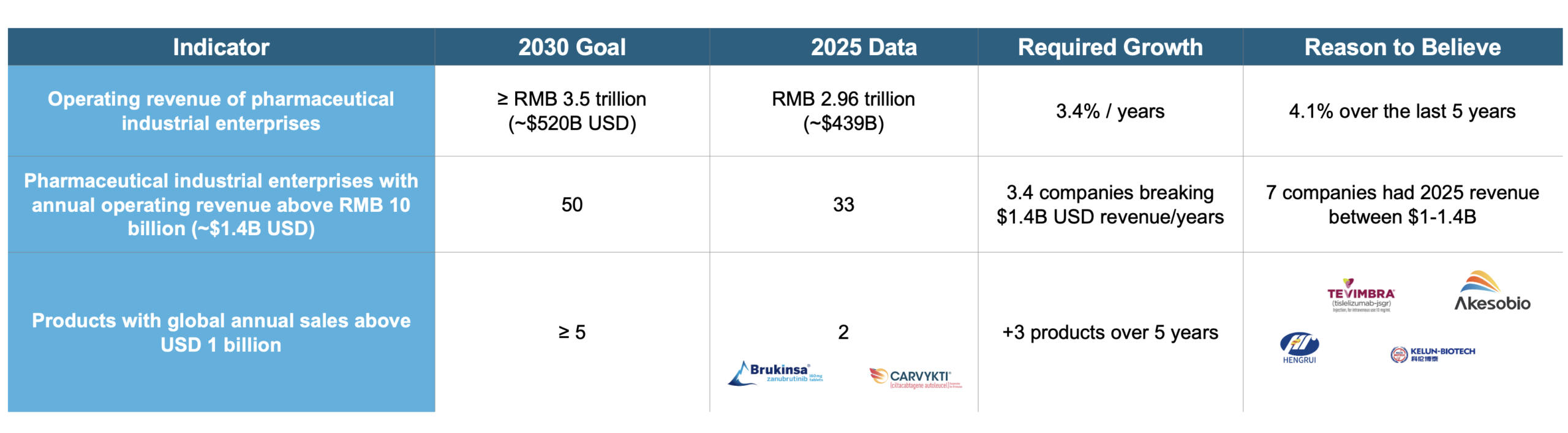
Table 1. Commercial Goals from 十五五 against the current state of the Chinese Biopharma Ecosystem
Moving from the current 2 blockbuster products, Brukinsa and Carvykti, to 5 by 2030 requires only 3 new blockbuster products, and BeOne’s Tevimbra ($737M sales in 2025), Akeso’s Ivonescimab, and Kelun/Merck’s Sac-TMT are poised to help achieve that goal. Hengrui’s HRS9531 (global rights licensed to Atlas portfolio company Kailera) is currently under review for NDA in China and could even be near blockbuster status from domestic sales alone (per analyst projections). Adding 17 pharmaceutical enterprises with revenue over $1.5B USD is also achievable given that 7 companies already had revenues between $1-$1.5B USD in 2025. Finally, on the overall operating revenue, utilizing Chinese government statistics, the industry is already well on track to pass the milestone. Going from 2025 operating revenue of ~$439B to the goal of $520B in 2030 only requires a ~3.4% growth rate each year, and over the last 5 years, China has already achieved a 4.1% growth rate.
On the development side, one could argue that Chinese Biopharma has already checked the boxes. China is indisputably a world leader in drugs entering clinical trials with sources reporting that in 2025, 46% of new molecules in clinical trials came from China and 50% of all innovative drug clinical trials were run by Chinese companies.
The headline number of >25% of global first-in-class drugs originating in China by 2030 is the most concrete proof of China’s aspirations to move beyond the fast-follower strategy and toward leading biology globally. Frankly, where this number actually sits today is difficult to pin down. The Chinese Biopharma bulls say that China is already there. Caixin, a Chinese business and financial news group, has published that China’s count of first-in-class candidates entering clinical trials rose to 120 by 2024, and claims that number represents 24% of the world’s FIC drug pipeline. Unfortunately, I don’t have the denominator here to prove that claim. The bears express concern that China won’t be at 25% even by 2030, often citing the need for stronger basic science research capacity.
Overall, the quantitative goals set out in the Plan seem relatively tame and well within reach. This reads to me as the Chinese Biopharma ecosystem getting comfortable in its growing position on the global stage and turning its focus to sustaining the steady growth that previous investment already built.
Ecosystem Building to Drive the Next Stage of Innovation
Beyond the numerical goals, the Plan lays out a roadmap to bolster the industry’s growth. The CCP’s focus on first-in-class products is evident in some of the highlighted research areas, including precision medicine and utilizing ‘omics work to uncover novel targets. And it would hardly be 2026 without an emphasis on integrating AI into biological research, drug discovery, and broader pharmaceutical and healthcare operations. AI relies on data, and the document even includes proactive advice on data management, encouraging the production of “trusted data spaces” to allow health data to circulate among various biopharma stakeholders.
The CCP demonstrates its understanding of some of the key ingredients to spark early innovation, including fostering hubs like Suzhou’s BioBAY or Kendall Square that bridge academics, hospitals, and industry. Now that biopharma has been declared a national emerging pillar industry, provincial governments are even further incentivized to want a hub in their backyard.
One major ingredient to novel biological innovation, however, is left unmentioned: academic funding. The 2026 Pharmaceutical Industry Plan was sponsored by 10 different government departments, including the Ministry of Industry and Information Technology, National Medical Products Administration, and even the Ministry of Agriculture and Rural Affairs! However, the Ministry of Science and Technology, which administers China’s basic research programs and national science foundation, is notably absent from this document, despite being part of the last Five-Year Plan. In fact, the 14th Five-Year Plan had set a goal of basic research taking up over 8% of R&D by 2025, but China missed that goal with basic research ending up at only ~7% of the Chinese R&D budget. Without investment at the basic science level, China’s first-in-class ambitions may be more difficult to achieve. Increasing the abundance of translatable academic science through increased academic funding will be key to driving the next stage of innovation.
China on the Global Stage
The Plan explicitly calls for “upgrading the level of industrial cooperation” beyond China’s borders. That cooperation should be bidirectional, with China leveraging its existing sphere of influence externally while continuing to attract international investment and collaboration into the country.
On bringing foreign interest into China, the CCP wants to specifically leverage the size of the domestic market to pull foreign pharma into deeper investment in China across R&D, clinical translation and manufacturing, in addition to encouraging joint R&D and joint commercialization. Although the threat of Chinese government action against foreign investment continues to loom large, this is one encouraging signal that the CCP sees the value that foreign collaboration has brought to the ecosystem to date.
On the other hand, many have wondered when Chinese pharmas will begin to deliver on their aspirations to become truly global multi-national commercial players, a question BioCentury took up just this week. BeOne is proof that a company with deep Chinese roots can get to real global commercial scale given the requisite time and resources (though it has now redomiciled to Switzerland). However, rather than aiming to juice commercial growth, the Plan more modestly proposes that Chinese Biopharma “cultivate international leading enterprises in market segments,” which reads more as a call for a healthy mid-cap pharma ecosystem rather than an attempt to build rivals to the top Western MNCs. The CCP seems to want steady and measured commercial gains, while keeping the focus on positioning China more and more as the leading global early innovation engine.
What’s on The Shopping List for the Next 5 Years?
The areas of interest articulated in the Plan read like a shopping list of hot topics in biotech. From technologies where China is already among the leaders (ADCs, nucleic acids, and cell/gene therapy) to more novel areas like macrocyclics and nanomedicine technologies, the Plan is evidence of deep technical understanding at the government level. For example, tumor microenvironment technologies are specifically and repeatedly mentioned throughout. A few themes stood out to me.
Delivery and route of administration are repeatedly brought up as an area of interest with multiple different technologies to achieve more convenient administration. This includes oral cyclic peptides, oral absorption enhancers, controlled release/long-acting technology, and mucosal administration (particularly for pediatric drug delivery and vaccines).
Unsurprisingly, conjugates are a consistent theme and appear to be the technology of choice, allowing modularity with bispecifics/multispecific antibodies or peptides dragging small molecules, radionuclides, siRNA, and ASOs to target tissues or tumors of interest.
Although many therapeutic areas are mentioned across the document, infectious disease is noted repeatedly across many sections, including as a priority area, with prophylactic vaccines for viruses such as RSV and Zoster being highlighted. Technology developments are called for with new vaccine adjuvants, combination vaccines and genetically recombinant vaccines. This is perhaps not surprising given the national security importance of infectious disease, and could be one area to watch for innovation coming out of China in the near future.
China has many state-affiliated investment funds that I imagine will use the 5-Year Plan as an investment mandate, so consider this a potential preview of the new technology platforms and novel assets that we will see emerging from China over the next 5 years.
Finally, there is one particularly interesting goal articulated near the end of the document: enhancing the social value of the pharmaceutical industry and cultivating the cultural value of the pharmaceutical industry. As it relates to the modern pharmaceutical industry, China explicitly aims to strengthen public awareness and understanding of pharmaceutical industry innovation and advancement through both school and public communication. There is a specific stated aim of more “cultural soft power” for the industry. I have deliberately refrained from comparing Chinese and American Biopharma up to this point, but given that 58% of Americans viewed the pharmaceutical industry negatively according to the 2026 Gallup poll, the US could probably pay attention to how China goes about trying to achieve its goal of better public understanding of what this sector contributes to society.
In conclusion, China will continue to loom large in the biopharma industry, so understanding how the CCP is thinking about the next 5 years is step one in crafting the best way to engage. The Plan, 十五五, is rich with many more details, from encouraging increased clinical trial enablement at clinical research centers to building shared manufacturing capabilities to lower the barrier for technology derisking. However, I hope you take two things from this appetizer:
- Ultimately, China knows its strong position in the global biopharma ecosystem and is actively taking steps to hold it by advocating for the industry to move upstream to become originators of biological innovation. Whether these aspirations will be realized may hinge, at least in part, on the level of support that China pours into its academic research capacity.
- Rather than pushing to accelerate China’s global commercial footprint, this Plan seems to recognize the value of cross-border collaboration in bringing what the government hopes will be Chinese-originated innovation out to the world. The CCP seems to be signaling tacit agreement to continued robust East-West biopharma collaboration, at least for the next five years.
Let’s see how these predictions land in 2030. I’m taking the over.
Special thanks to Tao Lan for sharing his expertise and read of the 5-Year Plan and Alex Harding for his feedback on this piece!