



By Abbas Kazimi, CEO of Nimbus Therapeutics, as part of the From The Trenches feature of LifeSciVC
This week, Nimbus reached another important milestone in our journey to deliver better medicines to patients, as our team initiated first-in-human dosing with our highly selective SIK2 inhibitor for immune-mediated inflammatory diseases. This moment is the culmination of years spent exploring a compelling biological hypothesis, overcoming difficult chemistry challenges, and ultimately creating a molecule with the potential to make a meaningful difference for patients living with diseases where better treatment options are urgently needed.
The milestone is particularly meaningful when viewed in the context of our broader journey. NDI-225673 is the second molecule we have advanced into the clinic in just two years, compared with three over the preceding 15 years. Throughout our history, every molecule we’ve declared a development candidate has successfully completed GLP-toxicology, with SIK2 continuing that track record.
These are encouraging measures of productivity, and I’m continually humbled by what our relatively small team can accomplish.
But what interests me most is what sits behind those numbers.
Drug discovery is an inherently uncertain endeavor. Biology rarely behaves exactly as we expect, and even the most promising molecules can stumble when they reach patients. So how do we build an organization capable of repeatedly identifying important therapeutic opportunities, solving difficult scientific problems, and advancing high-quality molecules into development?
The story of SIK2 offers a glimpse into how we’ve approached that question at Nimbus.
Learning From the Field: The SIK2 Opportunity
Some of the most interesting opportunities in drug discovery begin not with a new discovery, but with a fresh perspective on what others have already learned.
Despite remarkable advances in treating immune-mediated inflammatory diseases, too many patients never reach durable remission. Therapies targeting TNF, IL-23, and other inflammatory pathways have transformed care, but they have also left us with an important question: could we achieve more by intervening in the cellular machinery that regulates inflammation upstream, rather than targeting individual cytokines downstream?
The salt-inducible kinases, or SIKs, offered one intriguing possibility.
This family of three closely related kinases, SIK1, SIK2, and SIK3, plays a role in regulating inflammatory responses and other physiological processes. Galapagos had already invested substantially in this biology through its Toledo program, advancing molecules with different SIK isoform profiles into clinical studies across several inflammatory diseases.
Their work provided valuable early human evidence that SIK pharmacology could influence inflammatory disease biology, while also revealing the limitations of the molecules being studied. The progression from broader SIK inhibition to a dual SIK2/3 with their lead compound GLP-3970 inhibition left important questions unanswered: which isoform was driving the desired pharmacology, could sufficient target coverage be achieved, and might greater isoform selectivity unlock a better therapeutic profile?
Importantly, Galapagos itself acknowledged the potential importance of greater potency and SIK2 selectivity. At the 2022 J.P. Morgan Healthcare Conference, its then-CEO stated: “We need to find inhibitors to the SIK that are more active and likely more selective in inhibiting SIK2 than ‘3970 itself.”
For us, that was an intriguing place to begin.
Rather than develop another broadly active SIK inhibitor, we set out to test whether selectively targeting SIK2 could preserve the desired anti-inflammatory effects while avoiding unnecessary inhibition of the other family members.
This distinction was important. SIK1 and SIK3 have physiological functions beyond inflammation, including roles in cardiac and skeletal biology, and genetic and preclinical evidence suggests potential liabilities associated with inhibiting them. Our own experiments revealed a further distinction: selective SIK3 inhibition increased production of the pro-inflammatory cytokines IL-23 and IL-12 in human macrophages, an effect we did not observe with selective SIK2 inhibition (Nimbus AAI 2026 poster, Figure 3). In our view, inhibiting all three kinases wasn’t necessarily an advantage. It risked introducing unwanted biology while potentially undermining the very anti-inflammatory effects we were trying to achieve.
The opportunity was clear, but realizing it would require something much harder: a molecule selective enough to put that hypothesis to the test.
Better Chemistry Changes What Biology We Can Test
The three SIK kinases are remarkably similar in structure, particularly around their orthosteric binding sites, making selectivity with an orthosteric inhibitor a formidable medicinal chemistry challenge. This is precisely the kind of problem that has defined Nimbus over the years, where understanding the biology is only the beginning, and the real opportunity lies in designing a molecule that can test it.
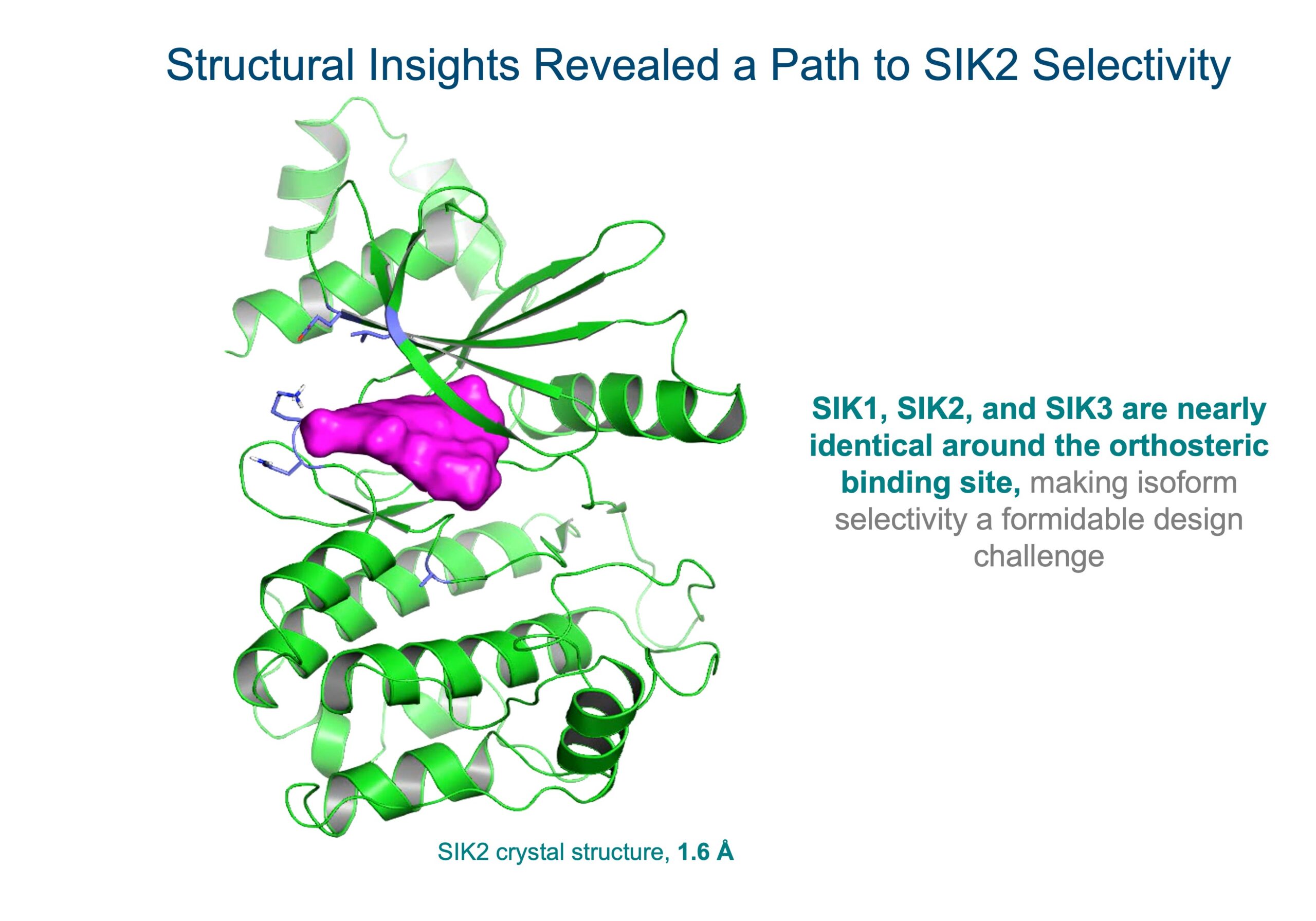
Our team combined high-resolution structural biology, structure-based drug design, computational chemistry, and iterative experimentation to understand the subtle molecular differences that might allow us to inhibit SIK2 while sparing SIK1 and SIK3. Rather than accepting the limitations of earlier compounds, we set out to solve the selectivity challenge directly.
The result was NDI-225673, a potent oral inhibitor with very high selectivity over the other SIK isoforms in preclinical assays.
Of course, the chemistry was never the end goal. What mattered was the biology it could unlock.
In human immune cell systems, selective SIK2 inhibition suppressed multiple pro-inflammatory cytokines, including TNFα, IL-6, IL-23 and TL1A. This was encouraging, although not entirely unexpected given earlier work on the pathway. What caught our attention was what happened alongside that suppression.
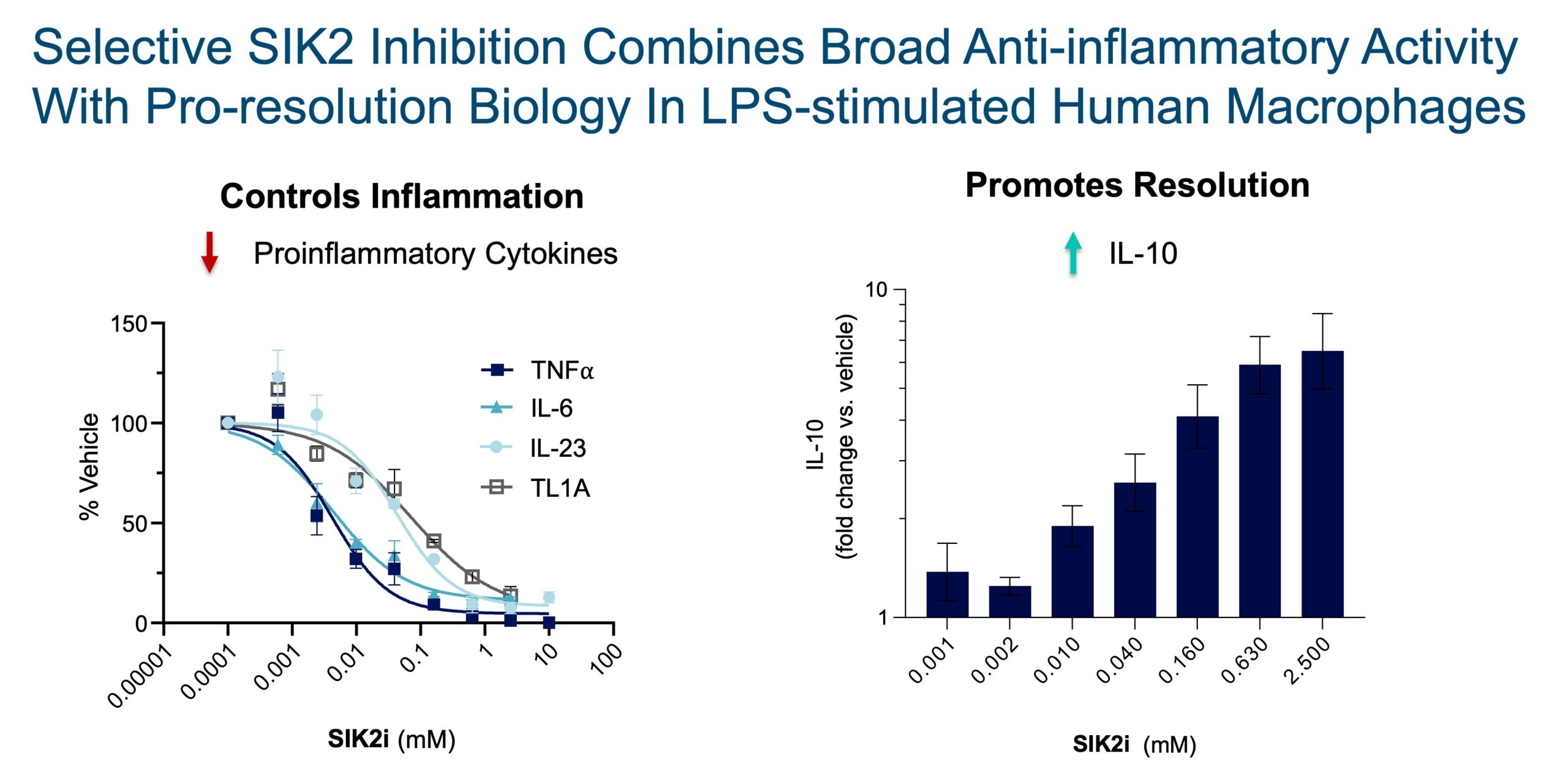
We observed increased production of IL-10, an important anti-inflammatory cytokine, together with amphiregulin and thrombospondin-1, mediators associated with tissue repair and the restoration of tissue homeostasis. Interestingly, selective SIK3 inhibition did not produce comparable increases in any of these tissue-repair mediators in our experimental systems, suggesting that the two kinases may play distinct roles in regulating inflammatory resolution.
This was particularly interesting because macrophages are not simply drivers of inflammation. They also help bring it to an end, clearing damaged tissue and coordinating repair. In chronic inflammatory diseases, that balance can become disrupted, allowing inflammation to persist long after it should have resolved.
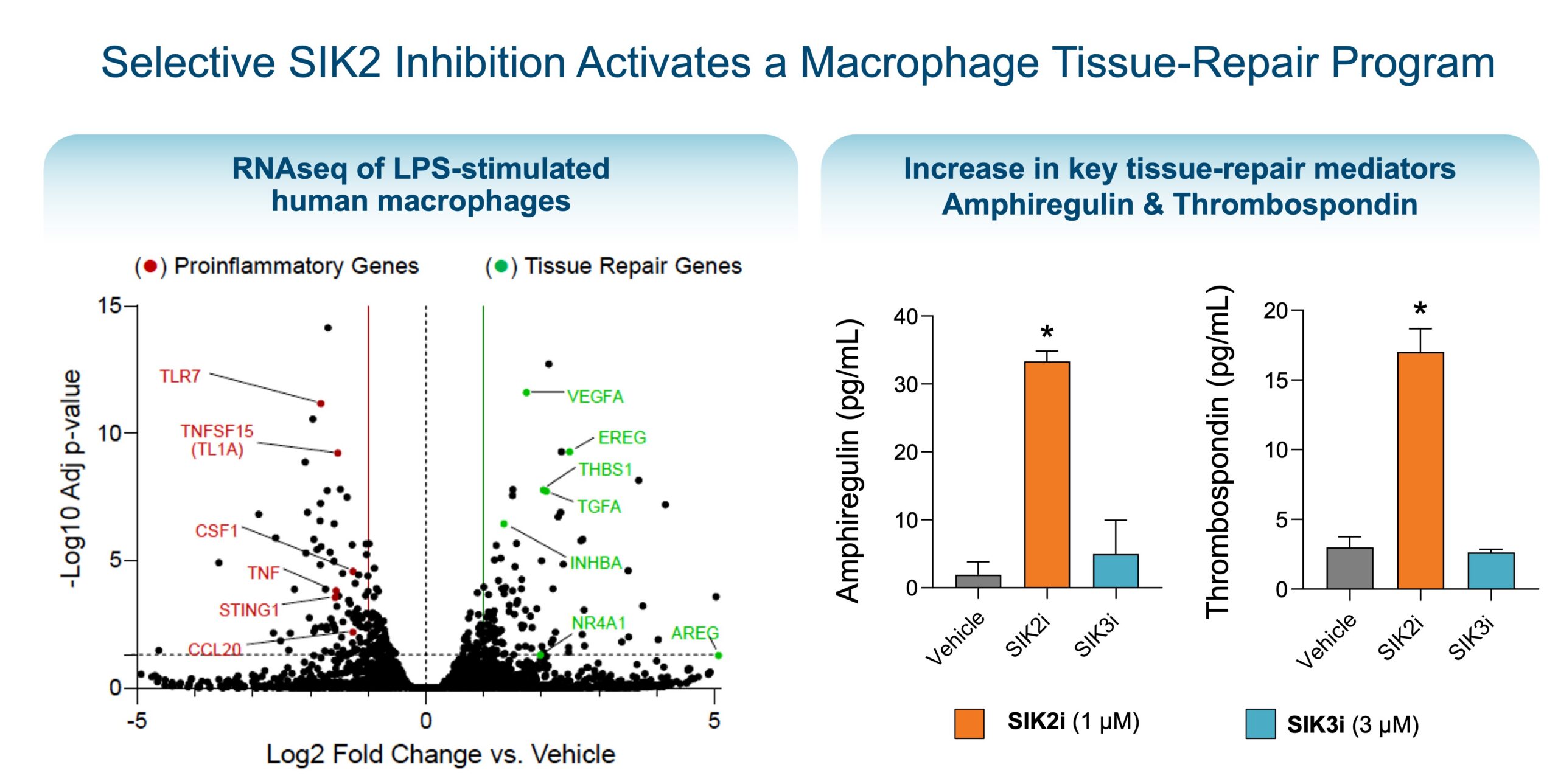
Our hypothesis is that selective SIK2 inhibition may act on both sides of this biology, suppressing inflammatory signals while supporting the body’s own processes for resolution and repair. This could be particularly meaningful in diseases such as ulcerative colitis, where the challenge is not simply controlling inflammation, but also restoring the integrity of damaged intestinal tissue.
We subsequently observed encouraging activity in preclinical models of inflammatory bowel disease and rheumatoid arthritis, including improvements in disease activity and markers of intestinal barrier integrity. Importantly, NDI-225673 also demonstrated a favorable preclinical safety profile, with no adverse findings in completed 28-day GLP toxicology studies and meaningful exposure margins.
Our ambition is to move beyond the efficacy ceiling of current treatments and explore whether this combination of inflammatory control and tissue repair could translate into faster, deeper, and more durable remission, ultimately reducing the need for patients to cycle through therapies.
Now we have the opportunity to begin learning what this means in the clinic.
Our Phase 1 study will evaluate safety, tolerability, pharmacokinetics, and pharmacodynamics through single- and multiple-ascending-dose cohorts. There is still much to establish, particularly whether the biology we’ve observed preclinically will translate into meaningful human pharmacology and ultimately clinical benefit.
But that is what makes this milestone so exciting: we began with important biology, learned from the clinical experience of others, and used better chemistry to create a differentiated molecule capable of answering a question that remained unresolved.
Repeatability Is About Learning, Not Repetition
Over the years, we’ve been fortunate to see Nimbus-discovered molecules advance through major transactions and partnerships with companies including Gilead, Takeda, Roche (Genentech), Bristol Myers Squibb (Celgene), and Eli Lilly. These programs spanned very different targets, therapeutic areas, and scientific challenges, yet the philosophy behind them has remained remarkably consistent.
We start with biology that matters, look for evidence that intervening in it can change the course of a disease, and bring together the scientific capabilities needed to create a differentiated molecule.
We’ve also never thought of Nimbus as a fixed technology platform. Different problems demand different approaches, and the tools we use should evolve alongside the science. What gives us confidence in our ability to repeat the process isn’t any single technology, but the learning that accumulates along the way.
Every program leaves something behind: a deeper understanding of biology, new insights into molecular design, better translational models, or simply the knowledge that a particular hypothesis wasn’t quite right. Some of our most valuable lessons have come from successful programs, while others have emerged from experiments that challenged what we thought we knew.
Over time, that accumulated experience becomes part of how an organization thinks, makes decisions, and approaches the next problem.
This is also where I believe advances in machine learning and AI are increasingly earning its place. At Nimbus, we’re deliberately integrating predictive models, computational tools, and increasingly capable AI agents into our discovery workflows, allowing scientists to connect information, draw on prior learning, and explore hypotheses with greater speed and precision.
The ambition isn’t simply to generate more molecules or automate more experiments. It’s to shorten the distance between a scientific question and a meaningful answer, a principle I explored earlier this year in my reflection on why owning the learning loop matters more than owning the lab.
Repeatability allows learning to compound and AI gives us new ways to accelerate that process.
The People Behind the Engine
When I reflect on Nimbus’s journey, what stands out most isn’t a particular technology, target, or molecule. It is, has been, and always will be the people.
For nearly two decades, we’ve believed that building a successful drug discovery organization doesn’t require building the largest one. We’ve deliberately remained lean and nimble, bringing together exceptional scientists, complementary capabilities, and a culture where curiosity, rigorous debate, and the willingness to challenge assumptions are part of everyday work.
Behind every development candidate are countless experiments, unexpected findings, difficult decisions, and people who care deeply about getting the science right. Much of that work happens quietly, far from the milestones and announcements that eventually mark a program’s progress.
As NDI-225673 enters the clinic, I’m especially grateful to the teams across Nimbus who made this possible. Their creativity, persistence, and scientific judgment allow us to tackle difficult problems, learn from one another, and continue pushing the boundaries of what a small organization can achieve.
We still have much to prove with SIK2, and ultimately our success will be measured not by the number of molecules we advance, but by whether they become meaningful medicines for patients.
For now, this milestone is an opportunity to celebrate the people who brought us here, and to reflect on what nearly two decades of learning have made possible.
Repeatability isn’t about doing the same thing again. It’s about building a team that keeps getting better at solving the next important problem.
Special thanks to Leon Collis (Executive Director of Biology at Nimbus and SIK2 Discovery Team Leader) for his thoughtful contributions and editorial guidance and to the entire SIK2 discovery team for their exceptional work.
Explore Our SIK2 Research
- ACR 2026: Suppression of inflammation and disease in mouse and human models of rheumatoid arthritis.
- DDW 2026: Selective SIK2 inhibition, intestinal inflammation, and mucosal healing.
- DDW 2026: Anti-inflammatory and tissue-repair activity in human UC models.
- AAI 2026: SIK2 selectivity, cytokine suppression, and pro-resolution signaling.
- ECCO 2026: Reduced inflammation and mucosal healing in colitis models.
- ECCO 2026: Translational evidence in human UC tissues.
